%20copy.png)
%20copy.png)
An Evening with Dr Shefali - Conscious Parenting, Humility and Ego
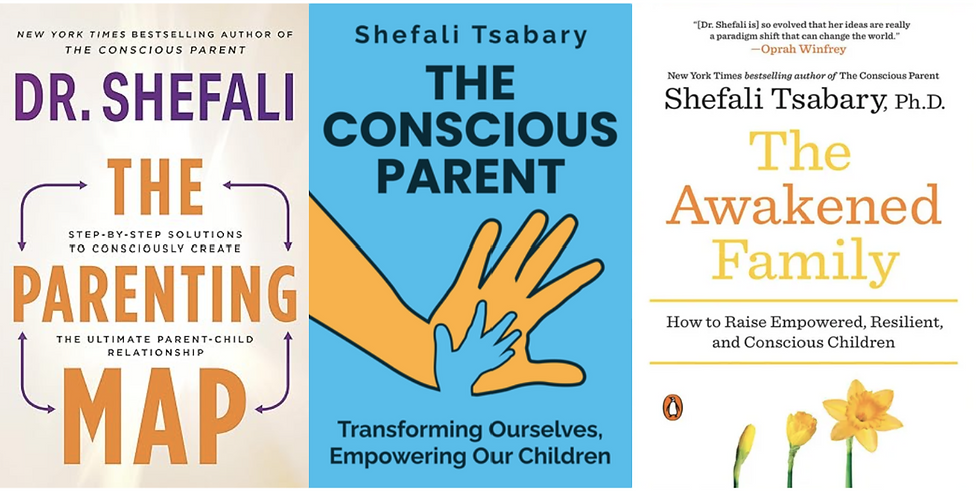
Last week I joined a theatre full of parents in Sydney to hear Dr Shefali Tsabary speak about conscious parenting. I walked in as both a psychologist and a mum, curious about how her ideas would land in real life parenting, not just in theory.
Dr Shefali is a clinical psychologist known for her books "The Conscious Parent", "The Awakened Family" and more recently, "The Parenting Map". Her approach blends Western psychology with Eastern philosophy and mindfulness.
Within the first few minutes, she made something very clear: This is not a parenting strategy talk and some of the home truths may feel brutal to parents, so stand by!
There were no sticker charts, no behaviour management tips, no scripts for bedtime negotiations. Instead, Dr Shefali delivered something closer to a gentle but relentless psychological mirror, and judging by the mixture of laughter and nervous shifting in seats around the room, many parents were feeling a little explosed.
The Core Idea: Parenting Is Not About Fixing Our Children
One of the most confronting, and liberating, ideas in Dr Shefali’s work is that parenting is less about shaping our children and more about transforming ourselves. This is something I talk a lot about in therapy and why one of the most important parts of therapy for my work with children and teen clients, is to involve their parents. Parents are humans too, and their responses to their children can go a long way in helping (or hindering) their kids development. However, for some parents, they become stuck in their own cycles of beliefs and expectations, and they miss what their child really wants and needs from them.
Dr Shefali’s ‘conscious parenting’ turns the usual model upside down. Instead of asking, “How do I fix my child’s behaviour?” it asks parents to look inward and consider their own emotional patterns, expectations and triggers. As she put it last night (with impeccable comedic timing): “Your children are not here to behave perfectly. They are here to expose you”. This line produced the kind of laughter that sounds suspiciously like mild panic.
The premise is that children often trigger unresolved emotional patterns in us, our impatience, our control, our need to be seen as good parents. When we react automatically, we are often reacting from our own childhood conditioning rather than responding consciously to our child in front of us.
In other words, parenting is one long opportunity for personal growth, whether we asked for it or not. We humans go through many developmental periods, childhood, adolescence, young adulthood, adulthood, middle age, old age – and each of these milestones brings it’s own changes and challenges. For those who chose to bring up children, parenthood is another developmental stage that we, as adults, go through and try to navigate - often with no real training or guidance.
Your Child Is Not a “Mini-Me”
Another theme returned to repeatedly was the idea that children are not extensions of us. They may look like it sometimes, but they are not mini versions of ourselves. They are not projects to perfect. They are not vehicles for our unfinished ambitions.
Instead, she describes children as individual beings with their own temperament, personality and path. Our job is not to mould them into who we think they should be. Our job is to create the conditions where they can become who they already are.
As a psychologist, I find this idea deeply aligned with developmental science. Children thrive when they feel seen for who they are, not when they feel pressured to become someone else. As a parent, this idea is occasionally inconvenient. Sometimes the person your child authentically is, happens to be the child who refuses to put on shoes, eat vegetables or go to bed before midnight. Dr Shefali’s point is that these moments aren’t separate from the work of parenting - they are the work.
Conscious Parenting Is About Awareness
One of the most practical ideas she discussed is the concept of parental awareness. Conscious parenting asks us to slow down and notice what is happening inside us when our children trigger strong reactions. Instead of immediately correcting the child, we pause and ask ourselves “why am I reacting so strongly?, “what expectation of mine is being challenged?”, “is this about my child, or about me?”.
This kind of self-reflection is central to the conscious parenting approach, which emphasises self-awareness, emotional regulation and mindful presence in parenting interactions. In other words, parenting becomes less about control and more about conscious responding. This sounds beautiful, but it is also very challenging when someone has just drawn on the wall with permanent marker.
Children as Mirrors
One of the most powerful metaphors she used during the talk was the idea that children act as mirrors for parents. Their behaviour often reflects our emotional environment. If we are overwhelmed, rigid or anxious, children tend to respond to that energy. Rather than viewing challenging behaviour as a problem to eliminate, Dr Shefali encourages parents to see it as information. “What is this moment revealing about our family dynamics?”, “what is it revealing about our own emotional patterns?”.
Children, she suggests, have an uncanny ability to expose the areas where we still have growing to do. Which explains why parenting can feel like an advanced emotional development course disguised as family life.
The Parent’s Ego (and Why It Causes So Much Trouble)
Another theme she returned to throughout the night was the role of parental ego. Many parenting struggles, she argues, come from our need to maintain control, authority or an image of being a “good parent”. When children behave in ways that challenge this identity, we can react with anger, shame or defensiveness. Conscious parenting asks us to loosen that grip. To accept that children will sometimes be messy, loud, emotional and inconvenient and that this does not mean we have failed. In fact, the goal is not perfect parenting. Dr Shefali often reminds parents that there is no ideal parent and no ideal child. There are simply humans learning alongside each other.
Presence Over Perfection
Perhaps the most comforting message of the evening was this - Children do not need perfect parents. They need present parents.
Presence means listening without immediately correcting. It means noticing our reactions before acting on them. It means allowing children to have their own emotions without trying to control them. It also means allowing ourselves to be imperfect. At one point she joked that parenting is essentially a lifelong practice in humility. Looking around the theatre, it seemed many of us agreed, and I am sure many of you can related to this internal battle between wanting to stay calm and connected, and the very human urge to control, correct or react.
My Takeaway as a Psychologist and Mum
Leaving the talk, I found myself thinking that Dr Shefali's ideas about conscious parenting, are not really about techniques. They are about awareness. And this was relieving, because my ethos in clinical practice, whether working with adults, children, couples or anyone in between, is that awareness is the first and most powerful step towards change.
Here, related to parenting, ‘awareness’ asks parents to slow down, look inward and recognise how much of our parenting is shaped by our own history, fears and expectations. From a psychological perspective, this makes a great deal of sense. Our early experiences shape how we respond to stress, conflict and relationships. From a parent’s perspective, it is both reassuring and slightly exhausting. It means that the work of parenting never really ends. But perhaps that is also the beauty of it.
It seems the message is that parenting is not simply about raising children. It is also about growing ourselves. If we can embrace this message, perhaps those long evenings when we feel utterly exhausted, can feel worth it – for our children, and for us! If we can hold this attitude, even 60% of the time, perhaps parenting wouldn't feel as much of a struggle or grind, so much of the time.
*Dr Shefali is a NYT bestselling author of 7 books, a Podcaster and has more than 1 million Instagram followers - check her out and decide what you think about the conscious parenting movement.


Comments